Godrej Kada Agrahara Gallery
The Godrej Kada Agrahara gallery previews the visual identity of the community taking shape at Kommasandra, Kada Agrahara — the 13-tower skyline, the central clubhouse and recreation precinct, the landscaped greens, the pool deck, and the representative apartment interiors. As a pre-launch project, the official photography and architectural renders will publish with the Godrej Properties brochure; the gallery below describes, frame by frame, the visual experience the design intent points to, so prospective buyers can picture the address before the launch imagery releases. Click any image to open the full-size lightbox. For visual checks, Godrej MSR City — Phase 3 is a same-city reference that helps separate brochure mood from evidence of elevation, landscape depth, finish cues, and usable community space.
What the gallery shows
A high-rise community is best understood through a sequence of views — the arrival, the skyline, the amenity core, the landscape, and the homes themselves. The Godrej Kada Agrahara gallery is built around the frames buyers most consistently ask to see, ordered the way you would experience the community in person: from the aerial overview down to the detail of a single apartment.
Aerial view of the 13-tower community
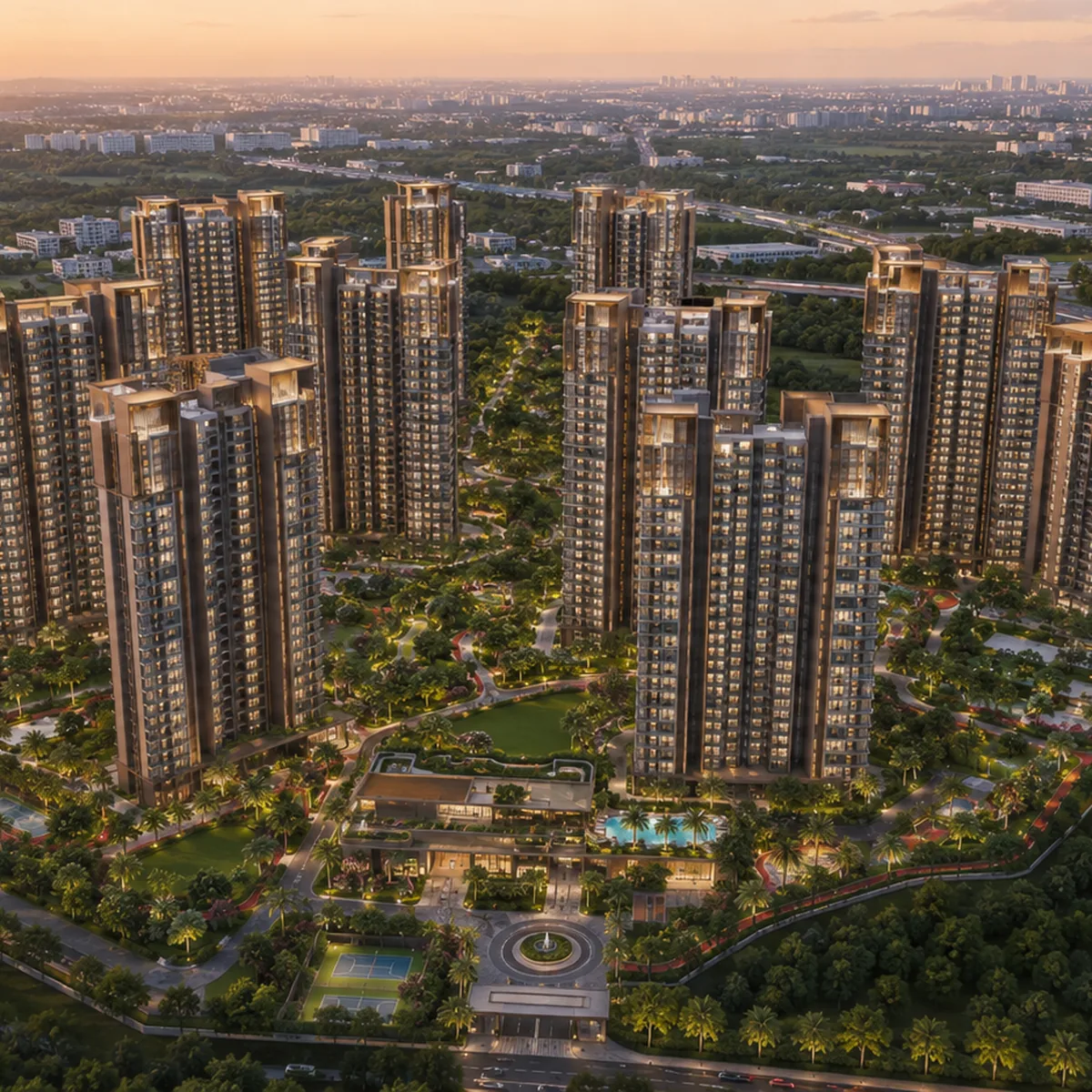
The signature frame is an aerial perspective of all 13 towers rising over the ~21.6-acre site, the central green spine and clubhouse precinct visible at the heart of the layout, with the Sarjapur Road corridor context spreading around it. The aerial view is the single most informative image of any large community — it shows the relationship between built mass and open space, the concentration of the towers into slim vertical forms, and the generous landscape released at ground level. The stepped tower heights, from G+31 to G+33, give the skyline a varied, layered profile rather than a uniform wall, and the aerial reveals how the towers are grouped to frame open courts rather than crowd them. From above, the green spine reads as a continuous landscaped artery threading between the tower clusters, connecting the entrance to the recreation core.
Campus and master-plan vignette
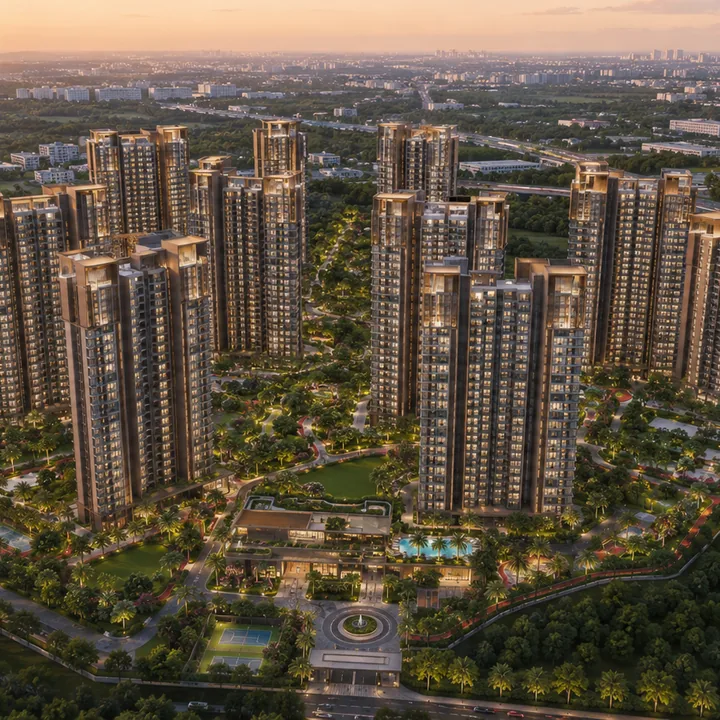
A second overhead frame zooms in on the master-plan organisation — the secured entry gateway, the internal driveway loop feeding the basement parking ramps, the central clubhouse precinct, and the way the sports courts, pool, and play areas are distributed through the landscape. This vignette is where a buyer reads the daily logic of the community: how far a given tower sits from the clubhouse, where the pedestrian routes run, and how vehicular movement is kept to the perimeter and below grade so the central zones stay calm and walkable. The campus view is the frame that turns a list of amenities into an understanding of how the community actually works. The full site logic is on the master plan page.
Tower facade and architectural detail
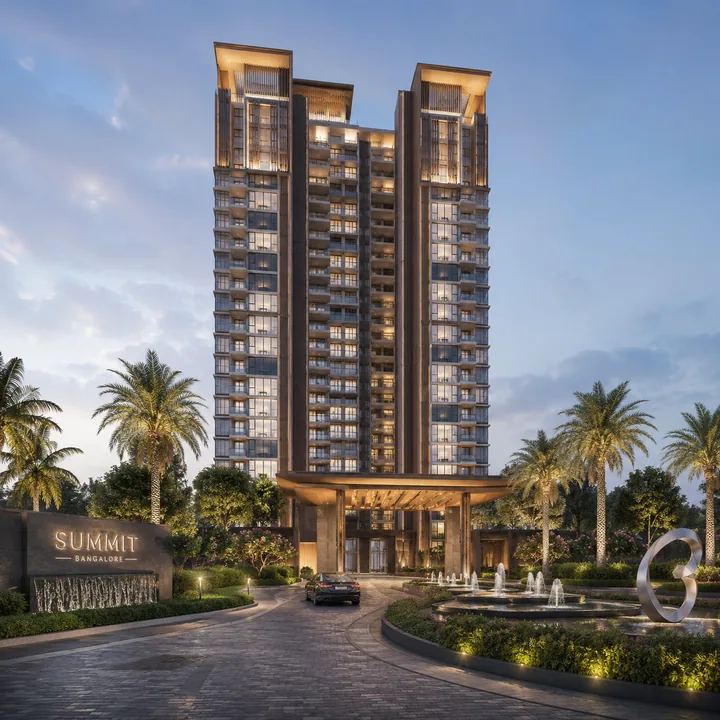
A ground-level frame of a tower rising over the landscaped arrival court captures the architectural treatment of the high-rise facade — the vertical rhythm of the balconies and window bays, the material palette, and the rooftop crown that gives each tower its silhouette. At G+31 to G+33, these are genuine high-rises, and the facade frame conveys both their scale and the finish quality that distinguishes a national-developer build. The detail in this frame — the balcony railings, the glazing, the entrance canopy — is what buyers study to gauge the project's quality intent.
Grand entrance and arrival lobby
The arrival sequence is the community's first impression, and a frame of the secured entrance gateway and the tower lobby conveys it: the boom-barrier-controlled gateway, the landscaped approach drive, and the double-height lobby with its seating, concierge desk, and finish materials. A well-resolved arrival — generous, secure, and finished to a high standard — sets the tone for the whole community and is one of the experiences residents value most in daily use.
The clubhouse and recreation precinct
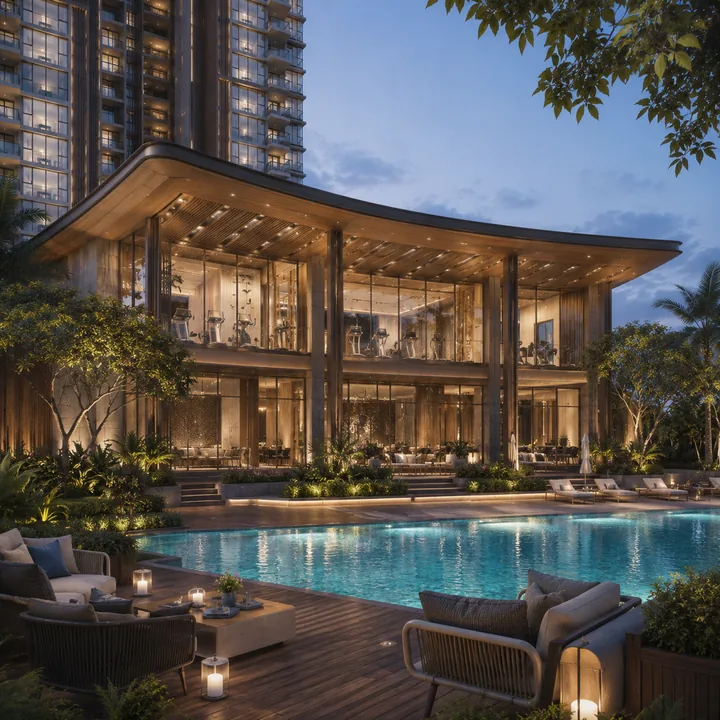
The social heart of the project: the grand clubhouse precinct at the centre of the master plan, opening onto the pool deck and recreation zones. This frame shows the amenity architecture — the clubhouse mass, the surrounding landscape, and the way the precinct anchors the community. For a 1,600-home development, the clubhouse is a substantial building, housing the gymnasium, multipurpose and banquet halls, indoor games, co-working lounge, and wellness facilities; its central placement keeps it within an easy walk of every tower. The frame captures both the exterior architecture and a sense of the interior volume. The full facility programme is on the amenities page.
Swimming pool deck
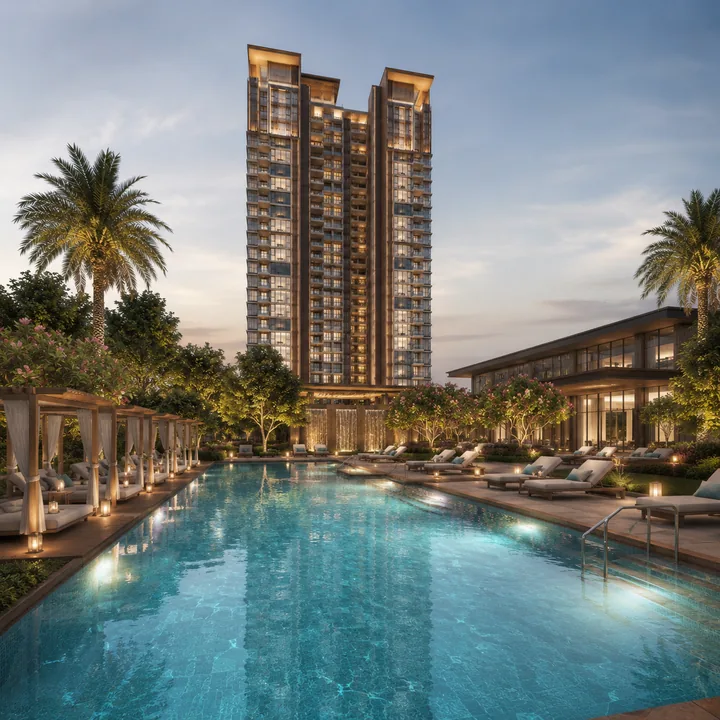
The swimming pool and deck at the central landscape, with the towers rising behind, is among the most-requested gallery frames. The pool deck is one of the most-used amenities in any Bengaluru community, and this frame conveys both the recreation quality and the relationship between the amenity core and the residences — the lap pool, the separate kids' pool, the surrounding deck and shaded seating, and the landscape that frames it. Captured at dusk, with the tower lights coming on behind the water, it becomes the project's most evocative single image.
Landscaped central green
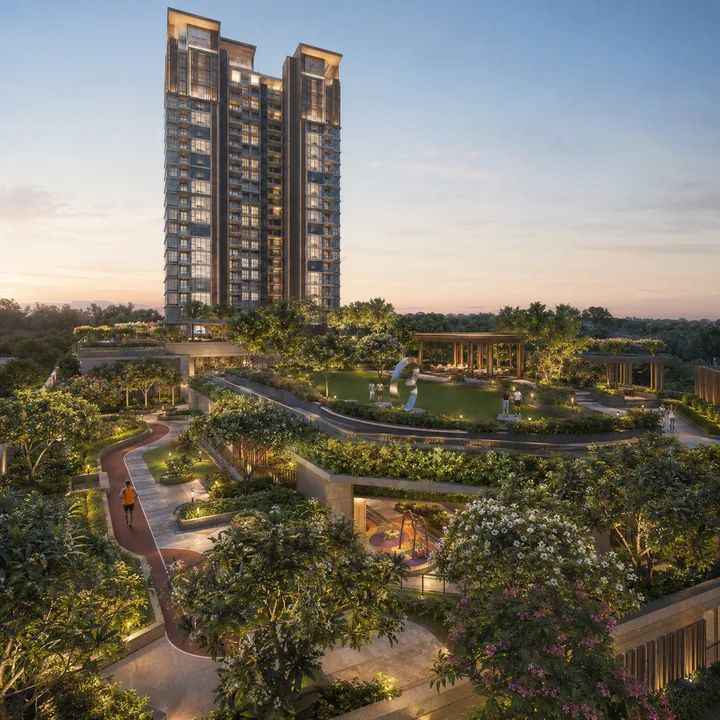
The central green spine and landscaped courts threading between the tower clusters — walkways, seating courts, water features, and the layered planting that fills the ground plane. This frame shows the open-space programming that the compact vertical massing makes possible, and the calm, green character the community is designed around. The landscape is not a single lawn but a sequence of zones — shaded groves, open lawns, water features, and activity courts — that give residents varied outdoor settings within the gates.
Amenity and activity zones
Frames of the themed activity zones bring the amenity programme to life: the children's play area with its equipment and soft surfaces, the senior citizens' plaza with shaded seating, the outdoor fitness and yoga decks, the indoor games room and sports courts, and the amphitheatre stepping down toward a stage. These views show the breadth of facilities that the project's scale supports, and they help families picture where their children will play and where the community will gather.
Representative apartment interior
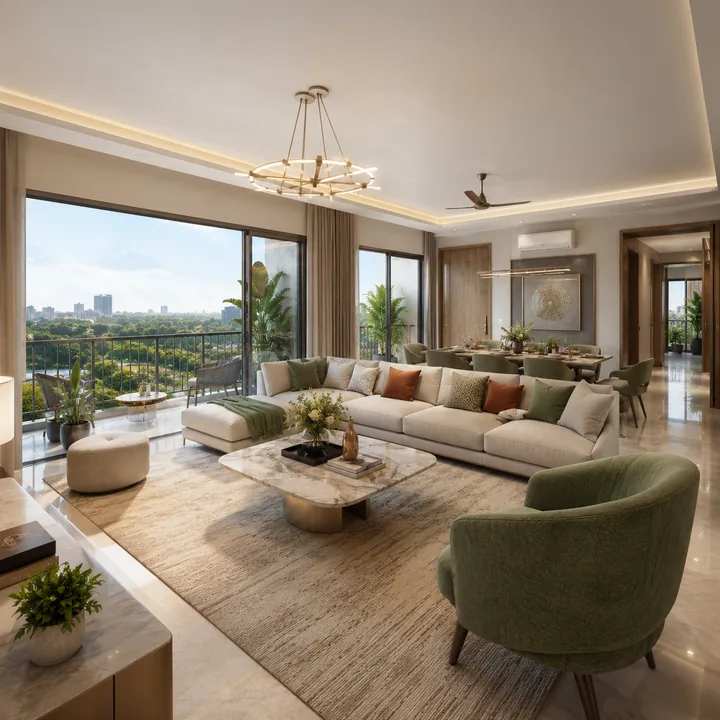
A representative interior — a living-dining bay or a model 2, 3, or 4 BHK home — shows the finish standard, the daylight from the balcony aspect, and the room proportions. The frame captures the flooring, the ceiling treatment, the window-to-floor proportion that determines how light fills the room, and the connection from the living space out to the balcony. Interior frames help buyers picture daily life in the home rather than just the community around it, and they are where the floor-plan dimensions become a tangible sense of space. See the layouts behind these frames on the floor plans page.
Balcony and view aspect
A frame from a balcony looking out conveys what a high-rise home at this address actually offers: elevation above the landscape, the long view across the corridor, and the outdoor extension of the living space. In a G+31 to G+33 tower, the upper-floor views are a genuine value driver, and this frame is what helps a buyer understand the premium that floor-rise and aspect command.
Night skyline and illumination
A night frame of the community — the towers lit against the sky, the landscape and pool deck softly illuminated, the entrance and clubhouse glowing — conveys the character of the address after dark. Lighting design is an underrated part of a community's identity: well-considered facade and landscape illumination turns the towers into a recognisable skyline and makes the common areas feel safe and inviting in the evening, when many residents actually use them. This frame is also where the scale of a 13-tower community reads most dramatically.
Location and corridor context
A contextual frame places the community within its surroundings — the Sarjapur Road corridor, the proximity to the Electronic City and Sarjapur tech belts, and the road and (future) metro connectivity. For a buyer evaluating an address, seeing the project in its corridor context — rather than in isolation — helps make sense of the commute, the employment catchment, and the infrastructure that drives the area's growth. This frame ties the visual tour back to the location and connectivity that underpin the investment case; the full detail is on the location page.
Construction and quality context
As the project progresses past launch, the gallery will add construction-stage frames — the foundation and basement works, the rising tower structure, and the formwork system — that let a buyer track real progress against the construction-linked payment milestones. For a national developer, these frames are also a quality statement: the construction methodology, site organisation, and safety standards visible on site reinforce the confidence the brand carries. Watching a community rise from foundation to topping-out is, for many buyers, the most reassuring sequence in the entire gallery.
A note on pre-launch imagery
Godrej Kada Agrahara is at the pre-launch stage, so the gallery presently describes the intended visual experience rather than final photography. Architectural renders and site imagery are typically released by Godrej Properties at the formal launch, alongside the brochure and cost sheet. As those visuals release, this gallery will be updated with the official renders of the towers, clubhouse, landscape, and apartment interiors, followed by construction-stage photography as the build progresses.
When evaluating launch imagery for any pre-launch project, buyers should read renders as design intent — a faithful representation of the architectural and landscape vision — and confirm the final specifications against the RERA-registered plans and the official brochure at booking. Godrej's house style favours restrained, accurate representation over exaggerated renders, which means the launch imagery can be taken as a reliable guide to the finished community.
See the community in context
The gallery pairs with the rest of this microsite to give a complete picture. The master plan page explains how the towers, clubhouse, and landscape are arranged across the site. The amenities page details the full facility programme the gallery frames preview. The floor plans page covers the apartment layouts behind the interior frames. And the location page maps the Sarjapur Road and Electronic City corridor context visible in the aerial views. To be notified the moment the official Godrej Kada Agrahara renders and photography release, register your interest through the contact page.
Want the HD renders and brochure?
Register your pre-launch interest and our sales team will share the official renders, the sanctioned master plan, and the full typology drawings as soon as the brochure publishes. A sales associate will respond within one working day.
Talk to a Sales ConsultantFrequently Asked Questions
Godrej Kada Agrahara Gallery — Frequently Asked Questions
The gallery previews the visual identity of the community - the 13-tower skyline, the central clubhouse and recreation precinct, the landscaped greens, the pool deck, and representative apartment interiors. As a pre-launch project, it presently describes the intended visual experience, ordered the way you would experience the community in person, from the aerial overview down to the detail of a single apartment.
Godrej Kada Agrahara is at the pre-launch stage, so the gallery presently describes the intended visual experience rather than final photography. Architectural renders and site imagery are typically released by Godrej Properties at the formal launch, alongside the brochure and cost sheet. Read renders as design intent and confirm final specifications against the RERA-registered plans and the official brochure at booking.
The signature frame is an aerial perspective of all 13 towers rising over the ~21.6-acre site, with the central green spine and clubhouse precinct visible at the heart of the layout. The aerial view shows the relationship between built mass and open space, the concentration of the towers into slim vertical forms, and the generous landscape released at ground level. The stepped tower heights, from G+31 to G+33, give the skyline a varied, layered profile.
Yes. A representative interior - a living-dining bay or a model 2, 3, or 4 BHK home - shows the finish standard, the daylight from the balcony aspect, and the room proportions. Interior frames help buyers picture daily life in the home rather than just the community around it, and they are where the floor-plan dimensions become a tangible sense of space.
Yes. As the project progresses past launch, the gallery will add construction-stage frames - the foundation and basement works, the rising tower structure, and the formwork system - that let a buyer track real progress against the construction-linked payment milestones. For a national developer, these frames are also a quality statement.
As the official renders and photography release, this gallery will be updated with the towers, clubhouse, landscape, and apartment interiors, followed by construction-stage photography as the build progresses. To be notified the moment the official imagery releases, register your interest through the contact page.